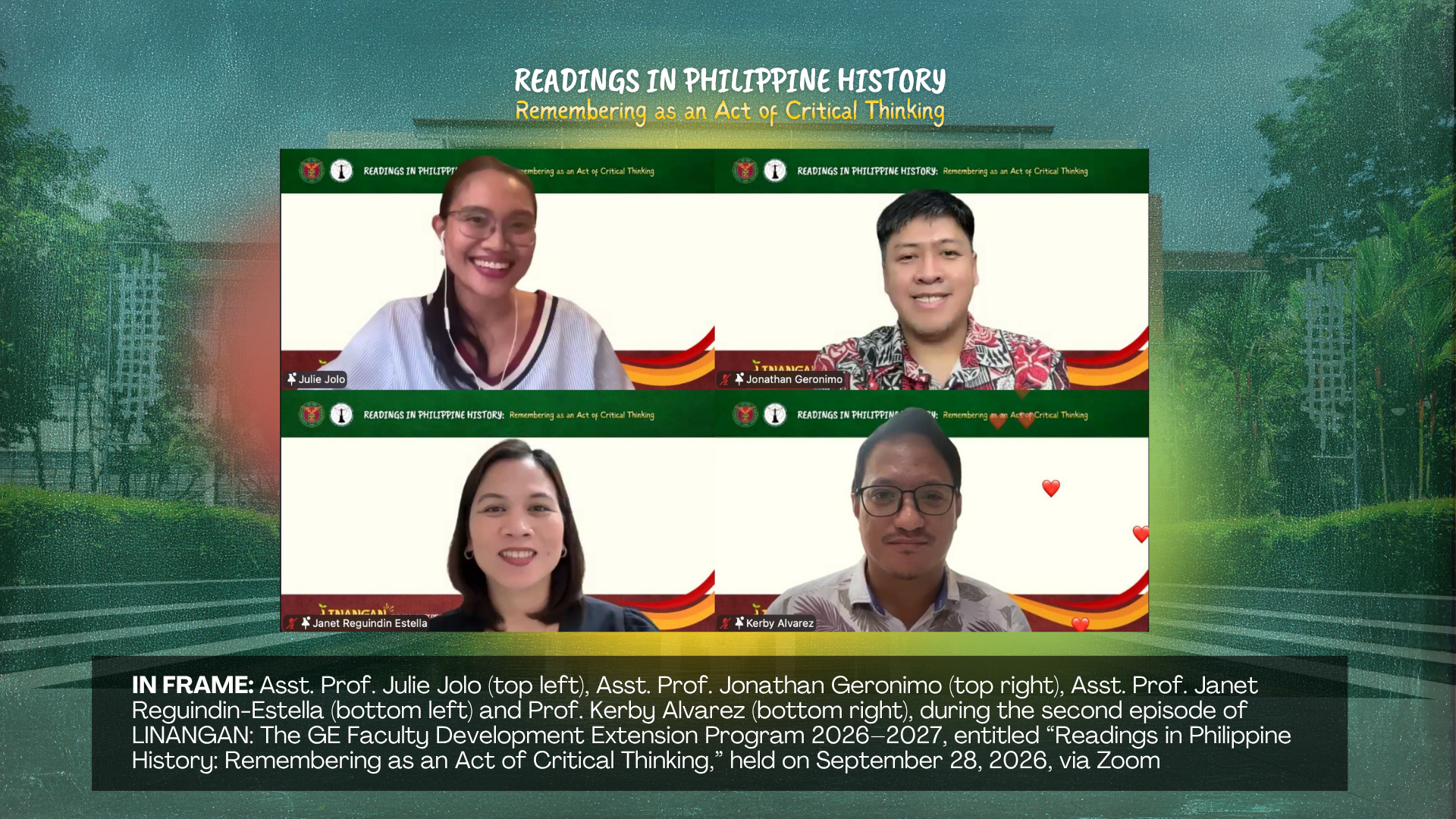
Following the resounding success of the pilot episode of the third cycle of LINANGAN: The General Education (GE) Faculty Development Extension Program 2026–2027 last 7 September 2026, the General Education Center (GEC) is back with its 2nd episode entitled “Readings in Philippine History: Remembering as an Act of Critical Thinking” aired on 28 September 2026 via Zoom and YouTube livestream.
Held in observance of the Martial Law Day of Remembrance on 21 September and in support of the Commission on Higher Education (CHED)-mandated GE course Readings in Philippine History, the webinar gathered approximately 2,000 participants from Zoom and YouTube. Through the three talks, the event highlighted the importance of remembering as an act of critical thinking and how history-based GE courses cultivate this skill by examining historical narratives, recognizing women’s contributions to Philippine history, and exploring how literature connects students to the past and its relevance to the present.
The webinar formally opened with welcoming remarks from Prof. Maria Vanessa Lusung-Oyzon, PhD, current Vice Chancellor for Academic Affairs (OVCAA) and former GEC Director. She underscored the importance of remembering as more than mere memorization, emphasizing its role in critical thinking and resisting historical disinformation.
“Recalling information is prone to forgetting, especially in the fast-paced world that we live in today. But today, we put remembering front and center as an act of critical thinking that helps us resist many issues that our nation faces, including historical disinformation and collective forgetting.”
Reflecting on her tenure as GEC Director from 2019 to 2020, she also shared significant milestones in the Center’s history and reaffirmed its continuing role in strengthening GE teaching and research.
“Ten years after its institution, this story still underscores how GEC continues to forward not only the improvement of teaching and doing research about General Education courses but also its critical role in remembering the weight of a GE course in our students’ curriculum and their overall learning.”
The first of the three talks featured Prof. Kerby Alvarez, PhD, of the Department of History, College of Social Sciences and Philosophy, wherein he explored how remembering Martial Law should go beyond simply knowing historical events and instead contribute to students’ holistic and principled development. He highlighted the role of GE courses in equipping students with the critical thinking skills and values necessary to assess historical narratives and navigate the spread of historical revisionism in the digital age. Dr. Alvarez also encouraged educators to engage younger generations in conversations about historical experiences they may not have personally witnessed.
“Bilang Gen Z ‘yung ating mga estudyante ngayon, kahit sa madalas may mga bagay na hindi tayo naiintindihan sa kanila. Ngunit let’s meet halfway, meet somewhere para mas maipaunawa natin ang isang panahon na hindi nila naranasan, pero mahalagang maunawaan. Sabayan natin ang mga Gen Z’s, let’s challenge them to go beyond what they know.”
The second talk, delivered by Asst. Prof. Janet Reguindin-Estella, PhD, of the Department of History, UP College of Social Sciences and Philosophy, highlighted the role of women in Philippine history. She discussed how studying women’s history can foster principled and socially aware students, emphasizing the responsibility of GE faculty to make women’s contributions more visible in historical narratives. She emphasized that conventional historical narratives frequently leave gaps in the representation of women’s experiences and contributions and that by making women more visible in historical discussions, GE faculty members can help students develop a more comprehensive understanding of the past and become more socially aware and principled citizens.
“Sa tradisyonal na naratibo ng kasaysayan, […] isa doon sa naisasantabing sektor ay ‘yung kababaihan. Ibig sabihin, gaya ng sinabi ko ‘dun sa general outline ng Philippine history, laging mayroong kulang sa mga binabanggit o laging mayroong espasyo na hahanapin mo ‘Saan ‘yung mga babae dito?’ […] Bilang mga guro at mas gusto natin makumpleto ‘yung kamalayan at kaalaman ng ating mga estudyante, mahalaga na hanapin natin at ilatag kung ano ‘yung role na ambag ng kababaihan sa kasaysayan ng Pilipinas.”
Following a short health break, Asst. Prof. Jonathan Geronimo, PhD, of the Departamento ng Filipino at Panitikan ng Pilipinas, UP College of Arts and Letters, delivered the final talk. He introduced PS 21: Wika, Panitikan, at Kultura sa Ilalim ng Batas Militar sa Pilipinas, a UP Diliman GE elective that examines Martial Law through the study of language, literature, and culture. He discussed how courses such as PS 21 foster critical and creative thinking while encouraging students to engage more deeply with historical experiences. Dr. Geronimo also highlighted the importance of these courses in a digital environment where complex historical events are often reduced to short videos, clips, and soundbites.
“Mahalaga ang kolektibong memorya bilang mahalaga at palagiang paalala na may makatarungang mundo tayong dapat maipagwagi. Sa panahon ng napakatinding krisis ng digmaan sa daigdig, […] at sa panahon ng Artificial Intelligence na humahamon sa ating mga sariling kapasidad, intellectually at culturally, higit na kinakailangan ang mga GE na humahamon sa henerasyong ito na mag-isip, magtanong, patuloy na umalala, unawain ang edukasyon higit sa balangkas ng ‘trabaho lamang’ […] Kundi, ang papel ng GE ay lumikha ng kinabukasan na gusto nating kolektibong likhain bilang isang lipunan.”
The three talks culminated in an open forum moderated by Asst. Prof. Julie Jolo of the Department of English and Comparative Literature, UP College of Arts and Letters. Drawing on questions submitted during registration and those raised in Zoom’s Q&A and comment sections, the open forum focused on effective strategies for teaching Readings in Philippine History to learners from diverse academic backgrounds and generations, particularly those with limited prior knowledge of or interest in history. Participants also sought recommendations for sources and repositories that faculty members could integrate into their classes.
The growing participation across LINANGAN sessions highlights the continuing need for spaces where GE faculty members from higher education institutions can exchange ideas, share teaching practices, and explore approaches to making GE courses more relevant and engaging for students.
The next session for this cycle of LINANGAN will be held on 26 October 2026 (Monday) and will feature the CHED-mandated GE course Mathematics in the Modern World. Interested participants may register for this upcoming session through this link. Meanwhile, individuals may rewatch the recorded livestream of previous LINANGAN sessions via GEC’s YouTube channel.