Bringing together the General Education (GE) faculty members, administrators, and academic leaders from across the constituent universities of the University of the Philippines (UP), the UP System GE Conference 2026, themed “Pagtanaw sa KaaGE: Through the Years,” was held on June 4–5, 2026, at the Institute of Biology, UP Diliman (UPD). Centered on the themes of looking back, looking through, and looking forward to the UP GE Program, the two-day conference featured keynote, plenary, and parallel sessions that provided a venue for participants to reflect on the fulfillment of the UP GE Program, review current teaching and learning practices, and reinforce the UP GE Program through critical assessment of potential changes in the educational landscape.
DAY 1: Looking Back and Looking Through
The two-day conference formally commenced with welcome remarks from Vice President for Academic Affairs Dr. Lorraine Pe Symaco, who cordially welcomed the UP faculty attendees from various constituent universities. This was followed by the opening remarks of UP President Angelo A. Jimenez, who drew from his experiences working across various cultures and contexts in the Middle East to highlight the impact and value of UP education. He noted that “Everything is observation, filtered with logic and reason,” emphasizing that at the heart of what the UP GE Program seeks to cultivate are students who do not merely absorb information, but who observe, question, and reason critically. Together, their messages foregrounded the two-day conference as a meaningful venue to reflect on, review, and reinforce the teaching and learning practices in the UP GE Program. 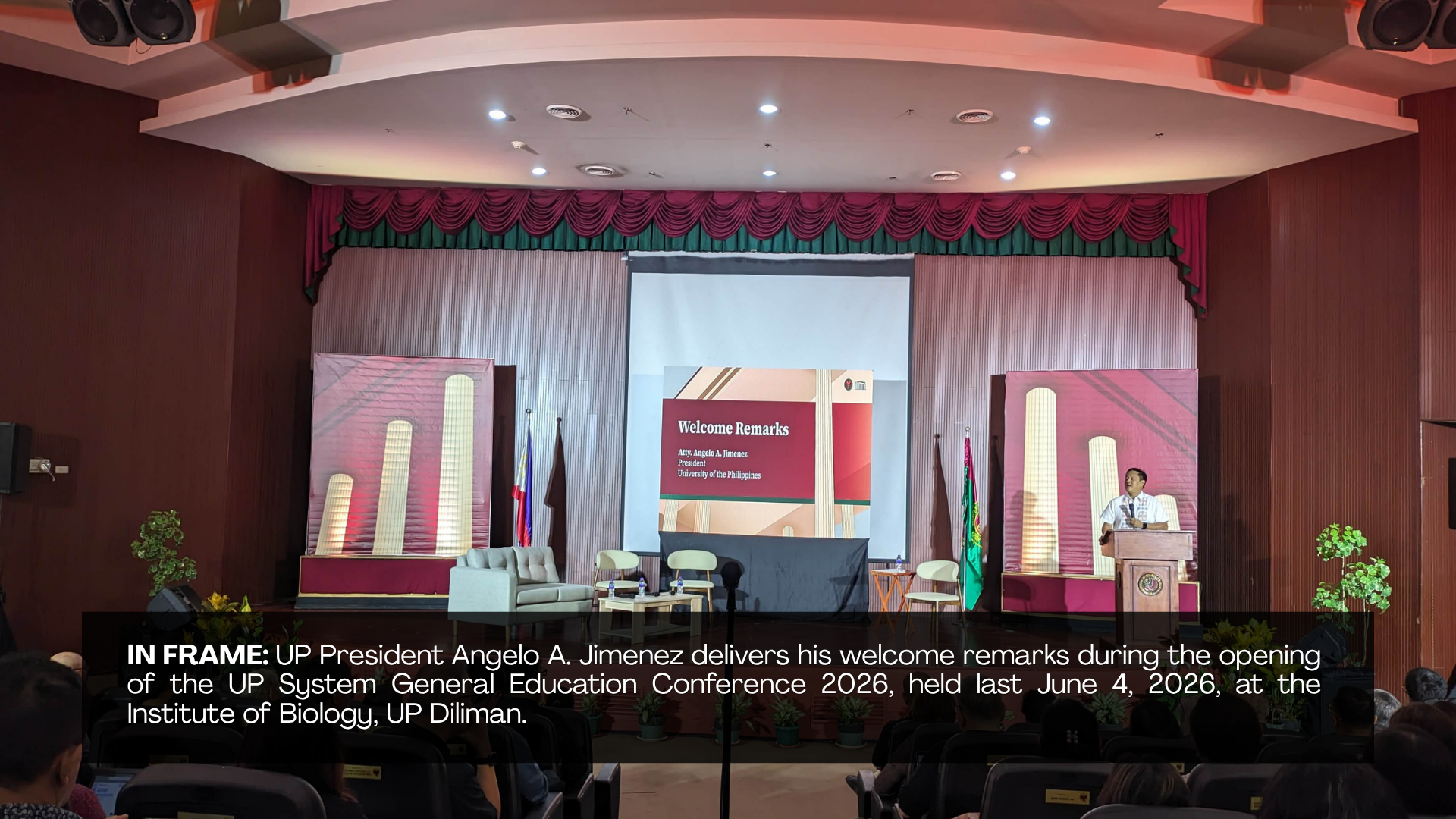
The event proceeded with the opening keynote, delivered by Emeritus Professor of Higher Education Martin Hayden of the School of Education, Southern Cross University, Australia, entitled “General Education in Australia: A Comparative Reflection on Outcome-based Education.” He emphasized the significant difference between the two educational contexts. While Australian higher institutions integrate graduate attributes across degree programs, such as critical thinking, communication, and ethics, without a specific GE program, the Philippines’ educational system follows a GE curriculum, strengthening holistic development among students. Examining Australia’s outcomes-based framework gave participants an avenue to gain information applicable to the teaching of GE, and offered insights on how the country’s Graduate Attributes Model could influence and inform the Philippine GE framework.
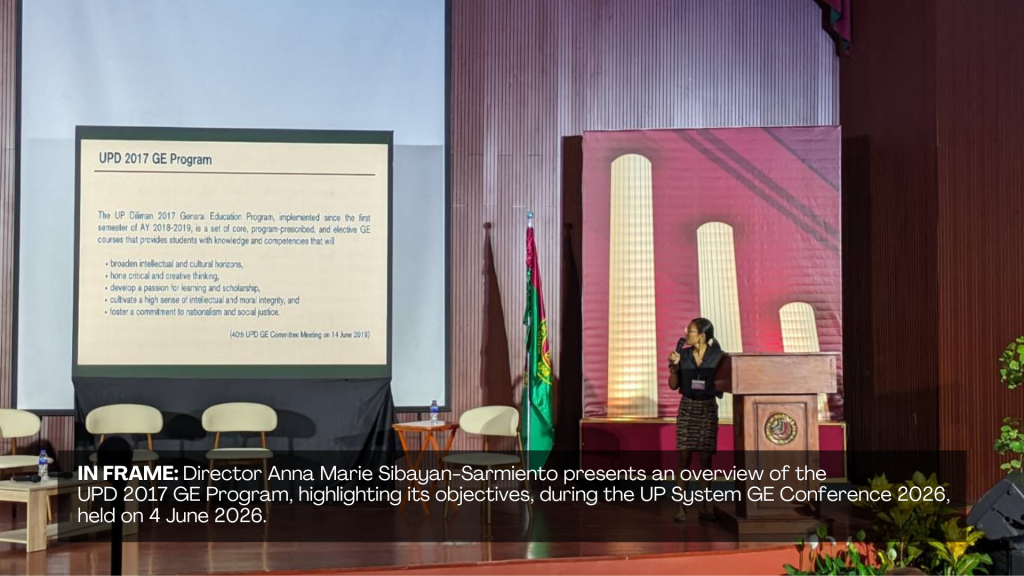
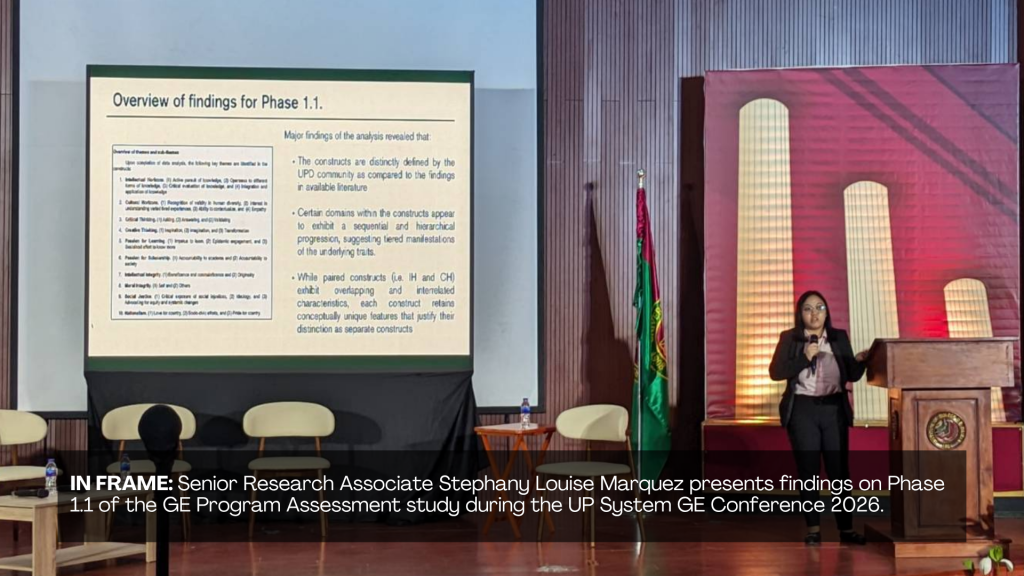
The conference featured a plenary session on “The UPD GE Program in different educational landscapes,” presented by the GE Center (GEC), where Director Anna Marie Sibayan-Sarmiento and Senior Research Associate Stephany Louise Marquez discussed the progress on the ongoing assessment of the UP GE Program. Director Sibayan-Sarmiento addressed the need to reassess the 2017 UP GE Program, which led to the study. She pointed out the lack of clearly defined indicators and operational definitions for the objectives of the GE program. Previous conferences had likewise highlighted the importance of measurable outcomes for proper assessment. Senior Research Associate Marquez then followed with an update on the study’s progress. Its first phase centered on focus group discussions (FGDs) with students and faculty, which generated key constructs for measuring student competencies aligned with the GE objectives. These constructs were then translated into test items, and the study was subsequently classified under Expedited Review following its review by the UPD Research Ethics Board. She also outlined the study’s next phases. The presentation provided other constituent universities with valuable insights regarding the state of the UPD GE Program and how it would contribute to refining the general education program across the UP system.
The open forum that followed raised questions and discussions on the keynote of Dr. Hayden, the plenary session presented by GEC Director Sibayan-Sarmiento and Senior Research Associate Marquez, and on the Proposed Policies, Standards, and Guidelines for the Reframed GE Curriculum by the CHED Technical Panel for General Education, with Mr. Ericson Reyes of CHED present to address concerns and inquiries for this matter. The forum was moderated by Assistant Vice President for Academic Affairs Ian Kendrich Fontanilla, who opened for questions that any speaker could respond to. Questions for Dr. Hayden focused on how the Graduate Attributes Model could contribute to the Philippine GE framework, and which graduate attributes are most important for students to develop and possess. Moreover, queries regarding the GEC’s presentation revolved around how the constructs were developed and how the term “construct” itself might be defined differently across disciplines. Meanwhile, questions directed at Mr. Reyes centered on the nature of the proposed reframing, particularly whether it signified the removal of existing GE courses and concerns about its implementation. The forum cultivated a meaningful exchange of ideas in pursuit of advancing the teaching and learning of general education.
In the afternoon, the UP GE faculty took part in parallel sessions held in breakout rooms, namely Looking Back and Looking Through, where various papers and topics related to general education were discussed.
Parallel Session 1: Looking Back
Reflect on the fulfillment of the UP GE Program objectives through the years.
(1:30 PM – 3:00 PM)
ROOM 1 (Institute of Biology Auditorium)
- Looking Back to Look Forward: Reaffirming the Public Mandate of the UP General Education Program in a Time of Educational Crisis
- Author: Early Sol Gadong
- Author: Early Sol Gadong
- From module writing to team-teaching: Reflections on Science 11
- Author: Aurelia Luzviminda Gomez
- Author: Aurelia Luzviminda Gomez
- Understanding Student Trajectories: A Statistical Examination of Cross-Enrolment, Dropout, Failure, and Extension Incidences at the University of the Philippines Open University (UPOU)
- Author: Ari Luis Halos
- Author: Ari Luis Halos
- Multi-, Inter-, at Transdisiplinariti sa Implementasyon ng WIKA 1 sa Unibersidad ng Pilipinas Los Baños
- Authors: Reynele Bren Zafra, Diane A. Manzano, and Daryl Q. Pasion
ROOM 2 (Institute of Biology Room 117)
- A Multi-year Review of Enrollment and Final Grades in Math 10 in UPLB
- Author: Destiny Lutero
- Author: Destiny Lutero
- From Anxiety to Affinity: A Mixed-Methods Analysis of Humanized Pedagogy in Math 10 using Aspect-Based Sentiment Analysis
- Author: John Justin Mesias
- Author: John Justin Mesias
- ARTS 1 at the Open University: Reflections on teaching creativity and criticality through Open Distance eLearning
- Author: Maria Alicia Sarmiento
- Author: Maria Alicia Sarmiento
- What we learn about our students from the Nuclear Cow Exercise
- Author: Mark Albert Zarco
- Author: Mark Albert Zarco
ROOM 3 (Institute of Biology Room 250)
- Pedagogical Reflections on Social Science 1: Evaluating Alignment, Student Engagement, and Creative Assessments
- Authors: Jay A. Yacat, Lizette S. Inocencio, Charmaine P. Galano, Polline Rae C. Domingo, and Julian R. Paterno
- Authors: Jay A. Yacat, Lizette S. Inocencio, Charmaine P. Galano, Polline Rae C. Domingo, and Julian R. Paterno
ROOM 4 (Institute of Biology Room 345)
- Public Speaking and Persuasion Pedagogy in Post-Pandemic Philippines: Responding to Shifting Political, Instructional, and Digital Contexts
- Authors: Charles Erize P. Ladia, Holden Kenneth G. Alcazaren, and Ma. Theresa D. de Guzman
- Authors: Charles Erize P. Ladia, Holden Kenneth G. Alcazaren, and Ma. Theresa D. de Guzman
ROOM 5 (Institute of Biology Room 2000-A)
- General education, specific contexts: the evolving pedagogy of Critical Perspectives in Communication (Comm 10) in UP Baguio
- Authors: Stephanie Luanne R. Lagasca, Jethro Bryan S. Andrada, and Markneel I. Balgos
ROOM 6 (Institute of Biology Room 2000-B)
- Reflections on the Importance of Principled Spaces in Teaching ETHICS 1
- Author: Raphaella Elaine Miranda
- Author: Raphaella Elaine Miranda
- Mula HISTORY I Patungong KASAYSAYAN 1: Mga Hamon sa Pagtuturo ng Kasaysayan ng Pilipinas Noon at Ngayon
- Author: Arthur Navarro
- Author: Arthur Navarro
- Tatak GE, Tatak UP Manila: Isang Panawagan Para sa Pagpapalawig ng Kasaysayan 5 (Kasaysayang Pangkalusugan sa Pilipinas) bilang GE Subject
- Author: Jerome Ong
- Author: Jerome Ong
- A history of a history course: Reflections on the evolution of Kasaysayan 1 in the University of the Philippines Dilim
- Author: Janet Reguindin-Estella
- Author: Janet Reguindin-Estella
Parallel Session 2: Looking Through
Review teaching and learning practices in the current UP GE Program.
(3:30 PM – 5:00 PM)
ROOM 1 (Institute of Biology Auditorium)
- Public Speaking and Persuasion in Changing Educational Contexts: Reflections, Restructures, and Reimaginations of Speech 30 Assessments
- Authors: Marvin Ray D. Olaes, Marielle Jutine C. Sumilong, and Kate Ashlyn N. Dayag-Nonay
ROOM 2 (Institute of Biology Room 117)
- Malikhaing Pagtuturo: Mga Danas at Aplikasyon ng Sining-Pasalita at Pampagtatanghal bilang Mabisang Pagganyak at Paglilinang-Wika ng mga Mag-aaral sa Kursong GE (WIKA 1: Wika, Kultura, Lipunan)
- Author: Andrew A. Estacio
- Author: Andrew A. Estacio
- Barangays x Twin Collabs: Nurturing a Sense of Community, Creativity, and Collaboration in KAS 1/HIST 1 in UPLB
- Author: Mark Jayson E. Gloria
- Author: Mark Jayson E. Gloria
- Serving the community beyond the classroom, campus and country by improving human and animal welfare through practice-based art theory education
- Authors: Lisa Elena Goddard-Paz and Kimberly Plomp
- Authors: Lisa Elena Goddard-Paz and Kimberly Plomp
- Pagsusulit, Pagsulat at Pagsalunga: Paglikha ng mga Malikhaing Pagsusulit na Kritikal sa Batas Militar
- Author: Mykel Andrada
- Author: Mykel Andrada
ROOM 3 (Institute of Biology Room 250)
- Nourished Minds: Reinforcing FN 1 in the UP GE Program for Lifelong Food and Nutrition Literacy
- Authors: Maria Carmela C. Taob and Airisse Rae P. Basinang
- Authors: Maria Carmela C. Taob and Airisse Rae P. Basinang
- Ang Tampoókan sa Hugpungang Wika, Kultura, at Lipunan: Tematikong Pagtatasa sa Estratehikong Dulog sa Pagtuturo ng WIKA 1
- Author: Nell B. Buenaventura
- Author: Nell B. Buenaventura
- Decolonizing Soc Sci 2? Reflections on teaching social, economic, and political thought
- Author: Aaron Abel T. Mallari
- Author: Aaron Abel T. Mallari
- Pag-ulayaw ng Agham at Kaibuturan: pagsipat sa pagpoposisyon sa wikang Filipino ng mga Mag-aaral ng WIKA 1 sa UPLB
- Author: Krisnah Ann M. Tan
- Author: Krisnah Ann M. Tan
ROOM 4 (Institute of Biology Room 345)
- Beyond the Peripheral Gaze: Using Mindanaoan Arts to Decolonize the National Culture Syllabus
- Author: Farah Aimee S. Virador
- Author: Farah Aimee S. Virador
- Transisyon at Transformasyon: Muling Pagdidisenyo ng Batayang Kaalamang Panggramatika sa Online na Konteksto ng General Education
- Author: Lari B. Sabangan
- Author: Lari B. Sabangan
- Examining effectiveness of online assessment tools using the Bloom’s Taxonomy for teaching MATH 10
- Author: Saraleen Mae M. Manongsong
- Author: Saraleen Mae M. Manongsong
ROOM 5 (Institute of Biology Room 2000-A)
- Pagsipat-suri sa Kasanayan at Pananaw-Mundo ng mga Mag-aaral ng WIKA 1 sa UP Baguio na Nagmula sa Kamaynilaan tungo sa Pagtutulay sa Hating Kultural
- Author: Felicisimo G. Galletes, Jr.
- Author: Felicisimo G. Galletes, Jr.
- Sentiment Analysis of MATH 10 Student Evaluations in UPLB from 2018 to 2025
- Author: Jonathan B. Mamplata
- Author: Jonathan B. Mamplata
- Understanding the SHOES of UPLB STS 1 Learners: Analyzing Learner Contexts Using Empathy Maps
- Author: Luigie Lursh G. Almojano
- Author: Luigie Lursh G. Almojano
- Curricular Mapping of UPOU General Education Courses for Sustainability Competency Integration
- Author: Leo Mendel D. Rosario
- Author: Leo Mendel D. Rosario
ROOM 6 (Institute of Biology Room 2000-B)
- Reflecting the Gaps in Mindanao Studies 1
- Authors: Theresa Mae E. Gallardo, Edward G. Estrera, and Malaya A. Lapiña
*This breakout room was dissolved, and the presentation was moved to Room 4 (IB Room 345).
- Authors: Theresa Mae E. Gallardo, Edward G. Estrera, and Malaya A. Lapiña
The first day concluded with a Fellowship Night at Atencio-Libunao Hall, providing participants with an opportunity to connect, enjoy, and socialize through a bingo game and a performance by Kontemporaryong Gamelan Pilipino (Kontra-GaPi).
DAY 2: Looking Forward
The second day began with a recap of the first day’s discussion on general education. The second plenary session then featured plenary presentations that examined the evolving role of technology, specifically, Artificial Intelligence (AI) in teaching and learning settings.
Assoc. Prof. Miguel Remolona opened the plenary session with his discussion on “Fundamental Pedagogical Shifts in General Education Due to the Presence of AI”, contextualizing the effect of AI on student learning in GE courses, stressing its potential benefits and risks. He pointed out that there is a gap between using AI and truly learning from it, cautioning against over-reliance that may give students the false sense of having learned. As a response, he outlined a three-step approach for teachers: knowing what AI tools students are using, setting guidelines on their proper use, and finding meaningful ways to incorporate them without compromising the quality of learning.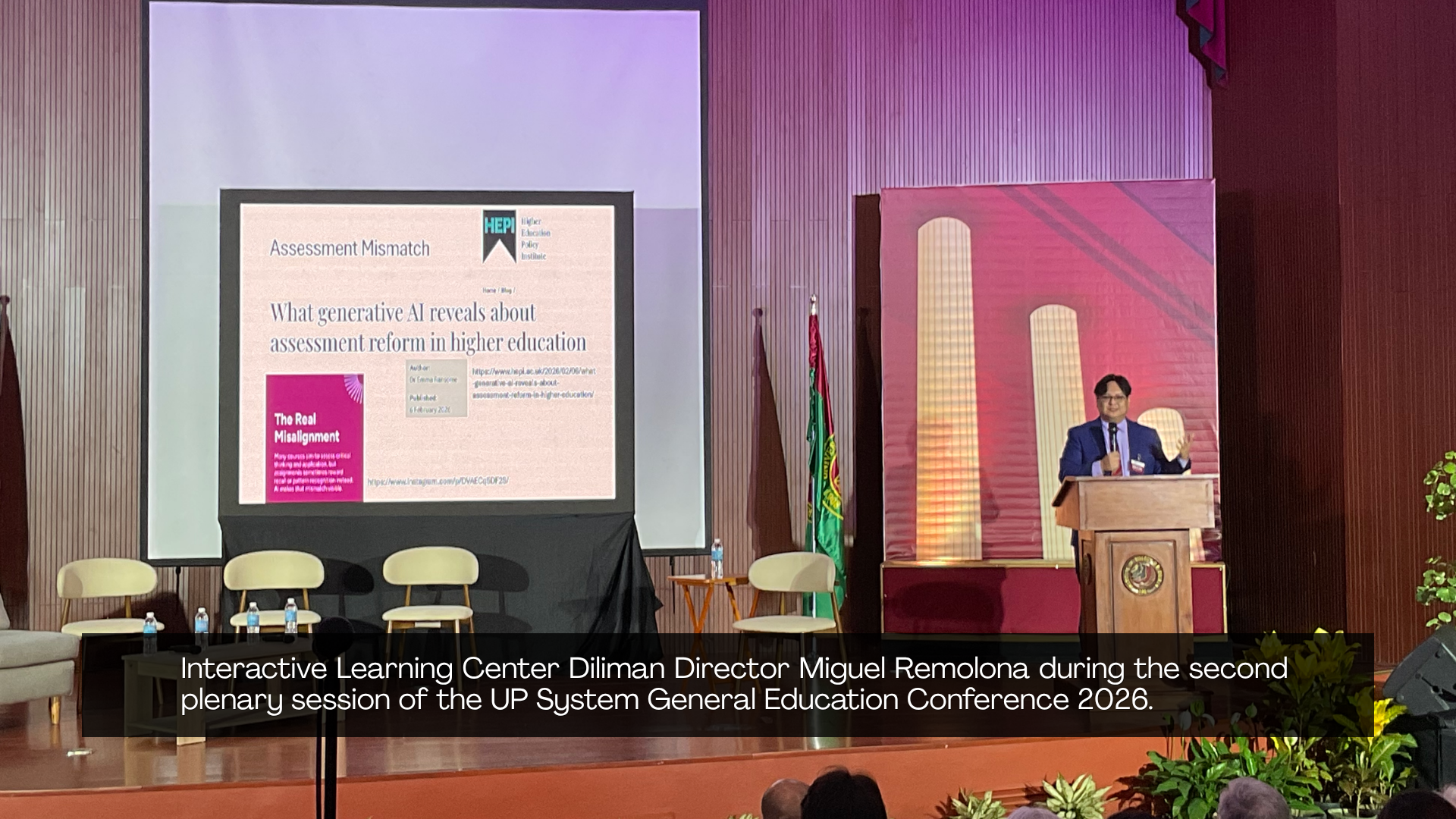 This was followed by Prof. Odine Maria De Guzman, who presented “Critical Thinking, Writing, and Autonomy in an Increasingly AI-Dominated Educational Landscape,” discussing from her own teaching experiences of how students currently engage with AI in their writing. She argued that amid this technological reality, teachers must find ways to keep students thinking and writing for themselves, encouraging ownership of their learning through practices that promote self-reflection and awareness.
Asst. Prof. Migel Antonio Catalig then presented “Memes, Prompted Images and Philosophies of Science: Reflections on Meme Output vs. AI-Generated Output in a General Education Class,” comparing student-made memes and AI-generated images as learning outputs in a GE course. While AI outputs were found to be more conceptually precise, student-created memes proved to be more personally meaningful and culturally grounded, raising questions about what GE assessments should truly measure in the age of AI. Moreover, while AI may produce more accurate representations of a lesson, it risks lessening students’ autonomous learning, innovation, and creativity.
To conclude the plenary session, Asst. Prof. Gregg Lloren presented “Teaching Through the Tremors: An Auto-Ethnographic Account of AI-Assisted General Education,” sharing how he integrated AI into his teaching during class disruptions caused by typhoons and earthquakes. Rather than viewing AI as a threat, he framed it as a collaborative tool or a mirror that, when used thoughtfully, can sustain and even deepen student learning amid challenging circumstances.
Altogether, the four presentations provided a space to think and reflect on the teaching and learning of general education in this growing digital society. The open forum that followed opened the floor for discussions and questions on how GE teachers can ensure that students utilize AI as a learning aid, not as a shortcut. One of the recurring questions posed during the forum was whether AI is truly a mirror of human beings, given that it does not possess emotion or the depth of what it means to be a human. This exchange of ideas fostered a meaningful reflection to critically examine the educational landscape of this time. 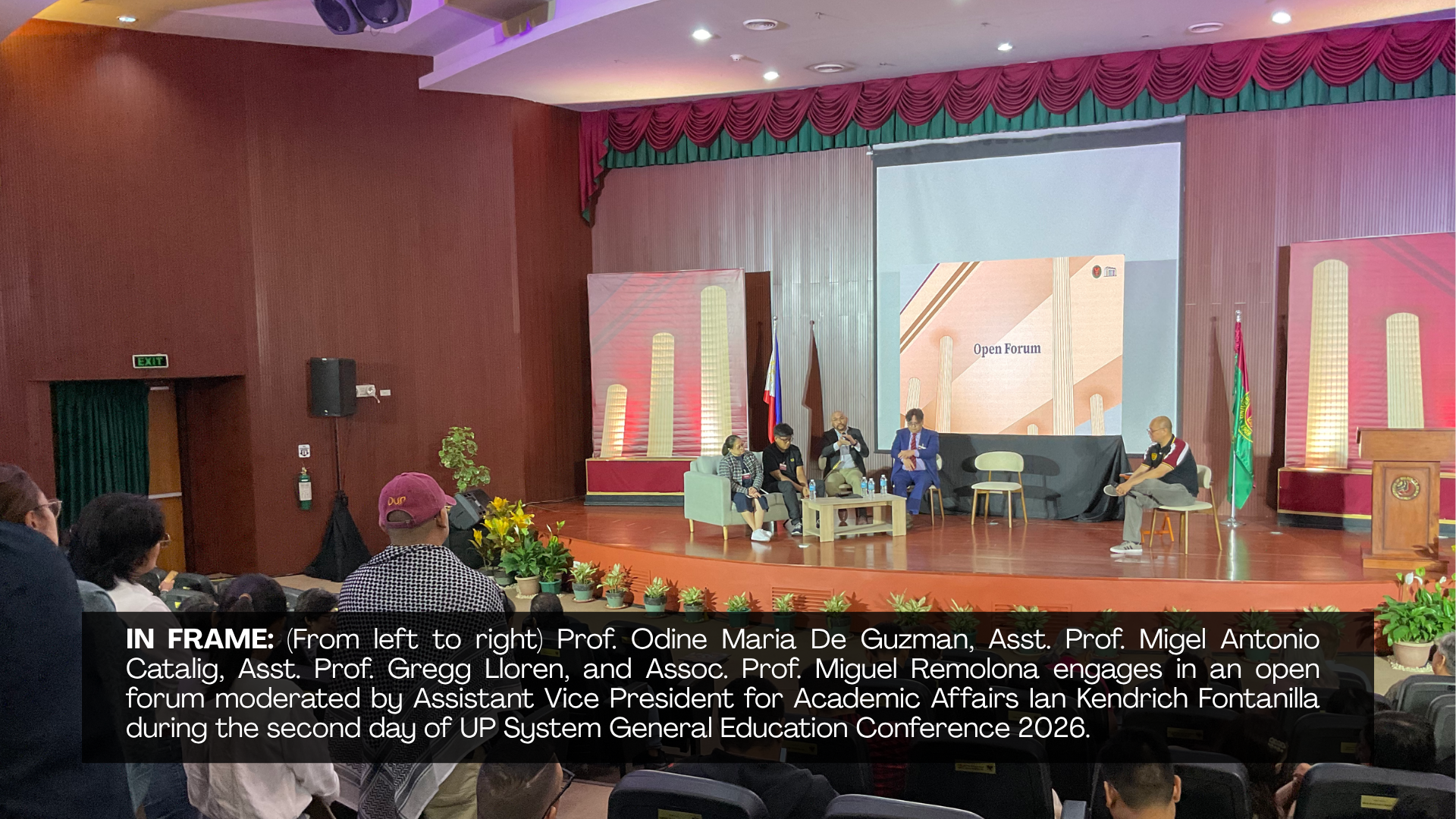 This was followed by the Parallel Session 3: Looking Forward, held simultaneously across six breakout rooms, where the delegates participated in, presented, and discussed papers on reinforcing the UP GE Program through critical assessment of potential changes in the educational landscape
Parallel Session 3: Looking Forward
Reinforce the UP GE Program through critical assessment of potential changes in the educational landscape.
(1:30 PM – 3:00 PM)
ROOM 1 (Institute of Biology Auditorium)
- Mainstreaming Human Rights Education in the General Education program of UP
- Authors: Early Sol A. Gadong, Carl Marc L. Ramota, and Rommel B. Rodriguez
- Authors: Early Sol A. Gadong, Carl Marc L. Ramota, and Rommel B. Rodriguez
ROOM 2 (Institute of Biology Room 117)
- General Education and UP’s fight against corruption
- Authors: Gerardo M. Lanuza, Rosa Cer D. Bragais, and Patricia Ruth P. Jasmin
- Authors: Gerardo M. Lanuza, Rosa Cer D. Bragais, and Patricia Ruth P. Jasmin
ROOM 3 (Institute of Biology Room 250)
- Service-Learning Through Tutorial Services: Motivation, Attitudes, and Perceived Value of UP Cebu Students
- Author: Kenneth A. Gallardo
- Author: Kenneth A. Gallardo
- GE as an Interdisciplinary Platform: Bridging Science, Humanities and Policy
- Author: Antonio Contreras
- Author: Antonio Contreras
- Decolonizing the General Education Curriculum: Towards Inclusive Knowledge Systems
- Author: Lucia P. Tangi
- Author: Lucia P. Tangi
ROOM 4 (Institute of Biology Room 345)
- Ang pangangailangan sa pagbabalik ng Kasaysayan 3 (Mga Relihiyon sa Asya) bilang kurso sa “General Education” sa mapaghamong panahon ng ika-21 na siglo
- Author: Emmanuel Jeric Albela
- Author: Emmanuel Jeric Albela
- Ang Kasaysayan Bilang Tulay sa Kaalamang Sekswal
- Author: Lester John Balita
- Author: Lester John Balita
- Ang Pagtuturo ng Kasaysayan 4 (Ang Kababaihan sa Kasaysayan ng Pilipinas): Mga Hamon, Oportunidad, at Tunguhin
- Author: Mary Dorothy Jose
- Author: Mary Dorothy Jose
ROOM 5 (Institute of Biology Room 2000-A)
- Teaching KAS 4 in UPLB: Challenges and Opportunities
- Author: Shine Relle Nunez
- Author: Shine Relle Nunez
- Two is better than one: Exploring the possibility of dividing HISTORY1 for a more holistic, high-impact, and responsive GE experience in developing competencies for Philippine History and Society
- Author: Reidan Pawilen
- Author: Reidan Pawilen
- Ang ‘Kasaysayan 2’ sa Panahong Digital at mga Reporma sa Basic Education sa ika-21 na Siglo
- Author: Wensley M. Reyes
- Author: Wensley M. Reyes
ROOM 6 (Institute of Biology Room 2000-B)
- Scoping Review on Values, Moral Principles and Virtues in Public Health Ethics for the DOH Code of Conduct Project
- Author: Ma. Paula G. Sioco
- Author: Ma. Paula G. Sioco
- Asian notions and nuances of Communication Theory as critical perspectives
- Author: Eric Joyce Grande
- Author: Eric Joyce Grande
- Performative Healing to Un-zombie the Zombie Effect
- Author: Banaue Miclat
- Author: Banaue Miclat
The second day ended with a synthesis presented by Assistant Vice President for Academic Affairs Ian Kendrich Fontanilla, who summarized the key discussions and insights gathered throughout the two-day conference. This was followed by an open forum led by Vice President for Academic Affairs Lorraine Pe Symaco, allowing participants to raise questions, share reflections, and engage in open dialogue on the future directions of GE in the UP System. Furthermore, the participants collectively presented and approved a statement expressing their opposition to the CHED’s proposed Reframed GE Curriculum.
The two-day conference was hosted by Prof. Jhoanna Lynn B. Cruz Daliling of the University of the Philippines Mindanao as Master of Ceremony. The GEC, alongside the Office of the Vice President for Academic Affairs (OVPAA), served as part of the Secretariat of the UP System GE Conference 2026. The conference’s theme, anchored in the spirit of “kaage,” a Bisaya term for yesterday, highlights the value of reflecting on the past to understand the present and make actions relevant to a better future. Through looking back, looking through, and looking forward, the UP System GE Conference 2026 underscored the importance of GE as a foundation of holistic learning and development in understanding the self, society, and the world. It remains a continuous pursuit of shaping critical, ethical, and socially responsive graduates for the country and beyond, reflecting honor, excellence, and service.