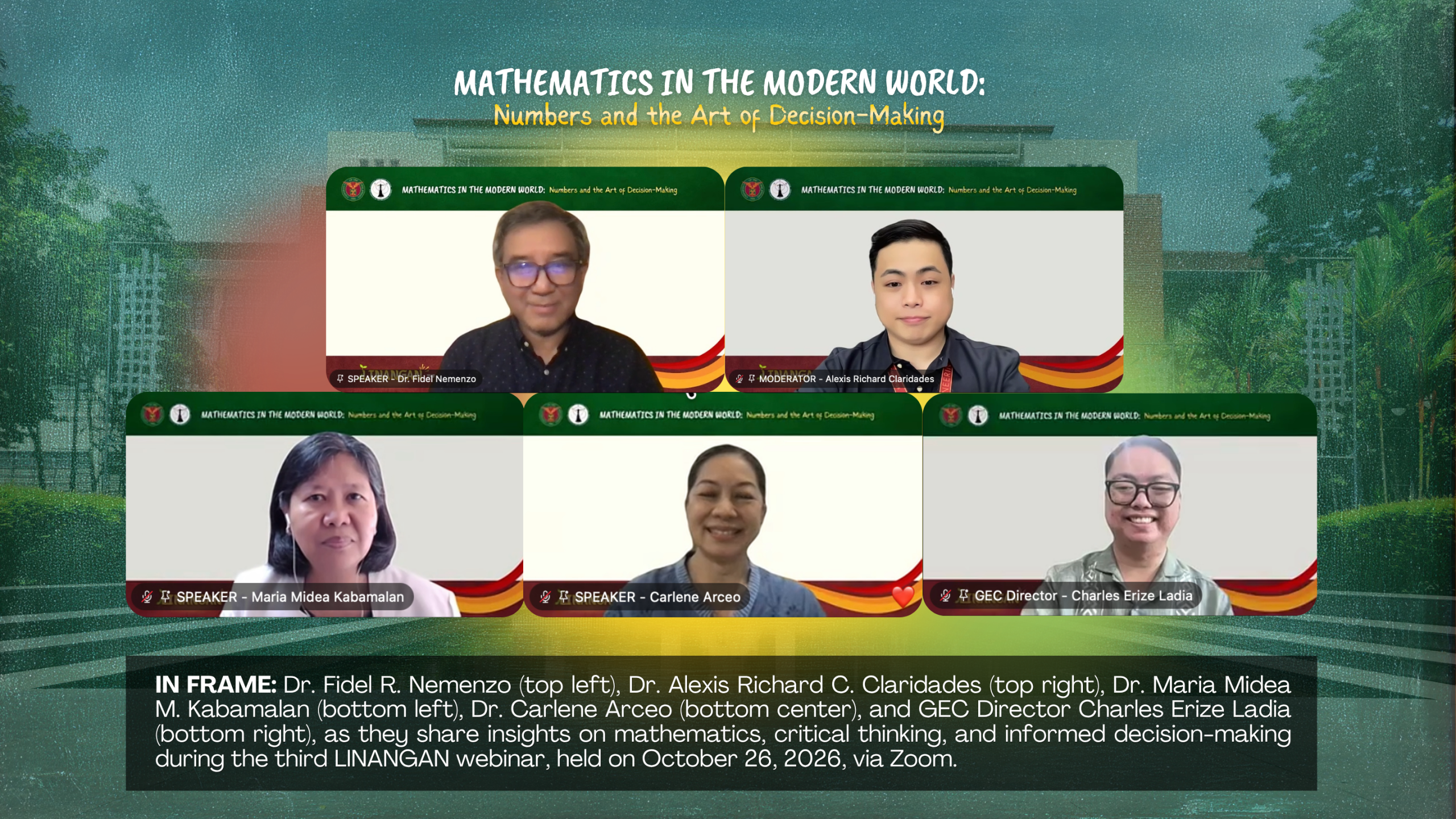
The General Education Center (GEC) continued the third cycle of LINANGAN: The General Education (GE) Faculty Development Extension Program 2026–2027 with its third episode entitled “Mathematics in the Modern World: Numbers and the Art of Decision-Making,” aired on 26 October 2026 via Zoom and YouTube livestream.
Held to highlight the significance of the Commission on Higher Education (CHED)-mandated GE course Mathematics in the Modern World (MMW) and in celebration of National Statistics Month observed annually every October, the webinar featured two talks and gathered approximately 1,200 participants across Zoom and YouTube. The session highlighted how mathematics extends beyond computation and can serve as an avenue for students to develop their mathematical literacy and critical thinking skills in interpreting information, addressing uncertainty, and making informed decisions in everyday life. It also underscored the importance of these skills in navigating an increasingly complex, data-driven, and digital society.
Similar to the two preceding episodes, the third episode formally opened with remarks from a former GEC Director, this time featuring Prof. Carlene Pilar-Arceo, PhD of the Institute of Mathematics, College of Science, who served as GEC Director from 2016 to 2018. Reflecting on her experience leading the Center, she recalled its establishment and highlighted how it has continued to evolve in response to changing needs over the years.
“It’s been ten years since the executive order […] reorganizing the OVCAA and creating the General Education Center Diliman. The Center has been so dynamic, responding to different needs at different times, and it has been exciting to witness.”
Dr. Arceo then introduced two key questions that framed her opening remarks: the place of mathematics in the General Education (GE) curriculum and the role of GE subjects in undergraduate education. She emphasized that mathematics, counting, and numbers have long been integral to everyday life and the development of human civilization. She further highlighted the complementary roles of specialization and GE, explaining that while specialization deepens students’ understanding of their chosen disciplines, GE courses broaden their perspectives by fostering an appreciation of how people in other fields think and approach problems.
“I like to say that specialization provides the vertical aspect of University education, while the GE provides the horizontal aspect for balance, for holistic growth, and interdisciplinary awareness. If you are an undergraduate, you go into your major subject to learn all about your discipline. You go into your area of focus such as your thesis topic and gain a deeper understanding of how those in your discipline think and act. But it is in the GE courses you will learn and appreciate how others, meaning those in the other disciplines, think. This appreciation is invaluable when you come to situations of problem-solving, decision-making, when fairness and sensitive judgment are called for.”
The third LINANGAN opened with Prof. Fidel R. Nemenzo, PhD of the Institute of Mathematics, College of Science, and former Chancellor of the University of the Philippines Diliman (UPD). He discussed how GE faculty members can use real-world issues and quantitative evidence to encourage students to question assumptions, identify misleading information, and make informed decisions on matters affecting individuals and society. He further emphasized that mathematical reasoning contributes to students’ holistic and principled development by equipping them with the ability to examine problems, evaluate arguments, and arrive at well-founded conclusions beyond simple computation.
“Math is not merely a collection of rules that is handed down by the authority to teachers. Math is essentially a way of asking questions, of making arguments, of testing ideas, of arranging, of arriving at conclusions that can be justified.”
Following Dr. Nemenzo’s presentation, Prof. Maria Midea M. Kabamalan, PhD of the UP Population Institute, College of Social Sciences and Philosophy, delivered the second talk. Anchoring her presentation on the curriculum and topics covered in the UPD GE elective Demo 1: Population Studies in the Contemporary World which examines population issues through demographic perspectives, she discussed how population and demographic statistics can be taught in ways that connect numerical data to the real-life issues and experiences of people. She emphasized that GE courses involving numbers, figures, and mathematics play an important role in developing students who are not only mathematically literate but also socially aware and capable of understanding the human realities behind statistical information.
“I think this is the beauty of demography. While we use data and use a lot of mathematical and statistical in examining those data, we do not lose sight of the fact that we are not only counting people, but we are in fact making people count.”
The two talks culminated in an open forum moderated by Assoc. Prof. Alexis Richard C. Claridades, PhD of the Department of Geodetic Engineering, College of Engineering. Drawing on questions submitted during registration and those raised by participants, the discussion centered on teaching strategies, pedagogical approaches, and classroom practices that can make MMW concepts more accessible, meaningful, and relevant to contemporary learners. Participants also explored ways to integrate abstract mathematical concepts, such as pattern recognition, into practical and data-driven applications that strengthen students’ functional mathematical literacy and quantitative reasoning.
The discussions throughout this LINANGAN episode highlighted the importance of connecting mathematical concepts to real-world contexts and social issues to make GE courses more meaningful and relevant to students. The sustained participation across LINANGAN sessions further reflects the continuing significance of GE in Philippine higher education and the need for spaces where faculty members from different higher education institutions can exchange perspectives, share teaching practices, and explore interdisciplinary approaches to strengthening GE instruction and fostering students’ holistic development.
The next session of this cycle of LINANGAN will be held on 23 November 2026 (Monday) and will feature the CHED-mandated GE course Purposive Communication. Marking a first for the LINANGAN series, the upcoming session will adopt an on-site and hybrid format, accommodating approximately 100 to 200 on-site participants alongside online attendees.
Interested participants may register for the upcoming session through this link. Meanwhile, individuals may rewatch the recorded livestreams of previous LINANGAN sessions via GEC’s YouTube channel.